



Overview
Biofilm testing is used to assess how effectively washer disinfectors remove biofilm associated microorganisms from internal surfaces during normal operating conditions.
Biofilm can develop over time and reduce the effectiveness of routine cleaning and disinfection if not properly controlled.
Routine testing provides assurance that equipment continues to perform as intended, supporting validation requirements, compliance with relevant guidance and ongoing decontamination effectiveness.
Standards and guidance
Biofilm testing is performed in line with:
- ISO EN 15883 Parts 4 and 5
- HTM 01-06, including Part D and E guidance where applicable
This testing is commonly recommended for endoscope washer disinfectors and other systems that do not employ high temperature disinfection.

Biofilm generation
To ensure biofilm testing reflects real operating conditions, a controlled laboratory system is used to generate a representative biofilm. This approach allows testing to be carried out in a consistent and reproducible way.
Biofilm generation involves:
- The use of PTFE tubing (6 mm internal diameter) to simulate internal surfaces found within washer disinfectors and associated equipment
- A nutrient growth medium designed to support the growth of relevant microorganisms, including Pseudomonas species commonly associated with water systems
- Continuous circulation using a peristaltic pump to encourage uniform biofilm formation along the tubing surface
- Controlled incubation at 30°C, supporting stable and consistent biofilm development
Under these conditions, biofilm is generated over 72 to 96 hours, producing a reproducible test surface suitable for evaluating washer disinfector performance.

Testing process
Once biofilm formation is complete, testing is carried out under controlled conditions designed to reflect the normal operation of washer disinfector systems.
The testing process includes:
- Tubing being prepared into 30 cm sections, allowing multiple test samples to be assessed consistently
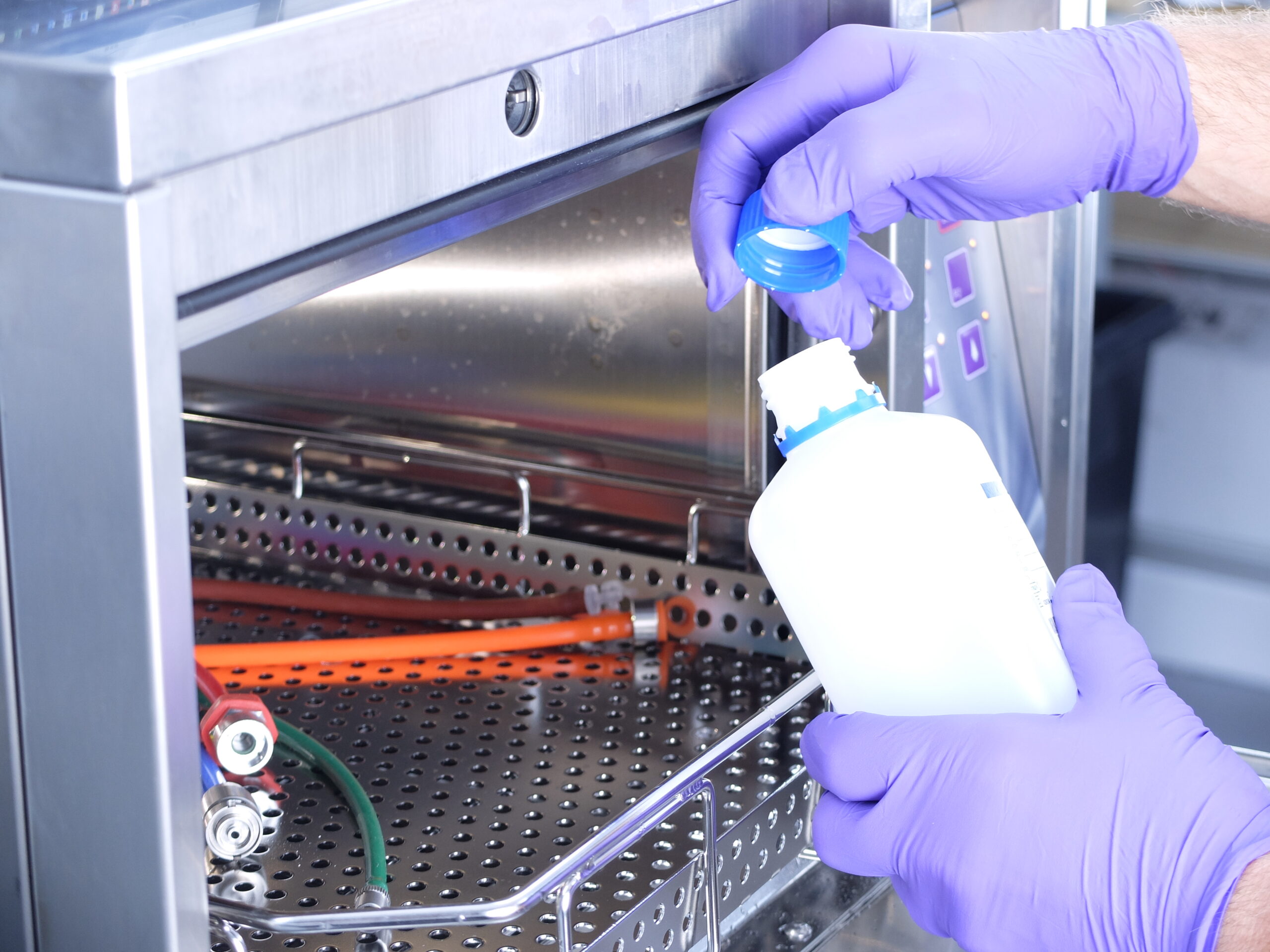
- Processing of the tubing through a standard washer disinfector cycle, carried out by a CPD (Competent Person Decontamination)
- Use of a cycle that reflects routine operational use, ensuring results are representative of real-world performance
Following the disinfection cycle, all tubing sections are returned to the laboratory for further evaluation.

Analysis and results
To assess the effectiveness of the disinfection process, any remaining microorganisms are recovered and quantified using validated laboratory methods.
Analysis includes:
- Calculation of a log reduction, which provides a clear measure of microbial reduction
- Assessment of how effectively the washer disinfector reduces biofilm associated microorganisms
- Review of results against relevant standards and guidance to confirm performance and compliance
This approach provides a reliable indication of whether washer disinfectors are operating in line with required decontamination standards.
You may also be interested in
Discover additional specialist services designed to strengthen your compliance framework and support safe, efficient clinical operations.